
Smart Wallets
Introducing Smart Wallets and Their Role in Driving Web3 Mass Adoption

Author
Author

Managing crypto shouldn’t be complicated and smart wallets are here to prove it. Unlike traditional wallets that can be hard to manage and easy to lose access to, smart wallets are designed to be simple, secure, and user-friendly.
These wallets often come with features like automatic backups, social logins, and built-in security, making it easier for anyone, even beginners, to manage digital assets safely. As more people get curious about Web3, smart wallets remove many of the barriers that slow adoption. They help users focus on enjoying Web3 experiences instead of worrying about passwords or private keys. In short, smart wallets are making crypto feel less technical, and that’s exactly what Web3 needs to grow.
Early crypto wallets were like digital safes where you had a key that unlocked your funds. Some wallets were custodial, meaning someone else held the key for you, while others were non-custodial, giving you full control. But with full control came big risks: lose your key or seed phrase, and your funds were gone for good.
As the crypto world grew, so did the need for wallets that could do more than just store keys. Users wanted safer, easier ways to manage their assets without all the stress of remembering complex phrases or worrying about losing access. This demand set the stage for smarter, more adaptable wallet solutions to emerge.
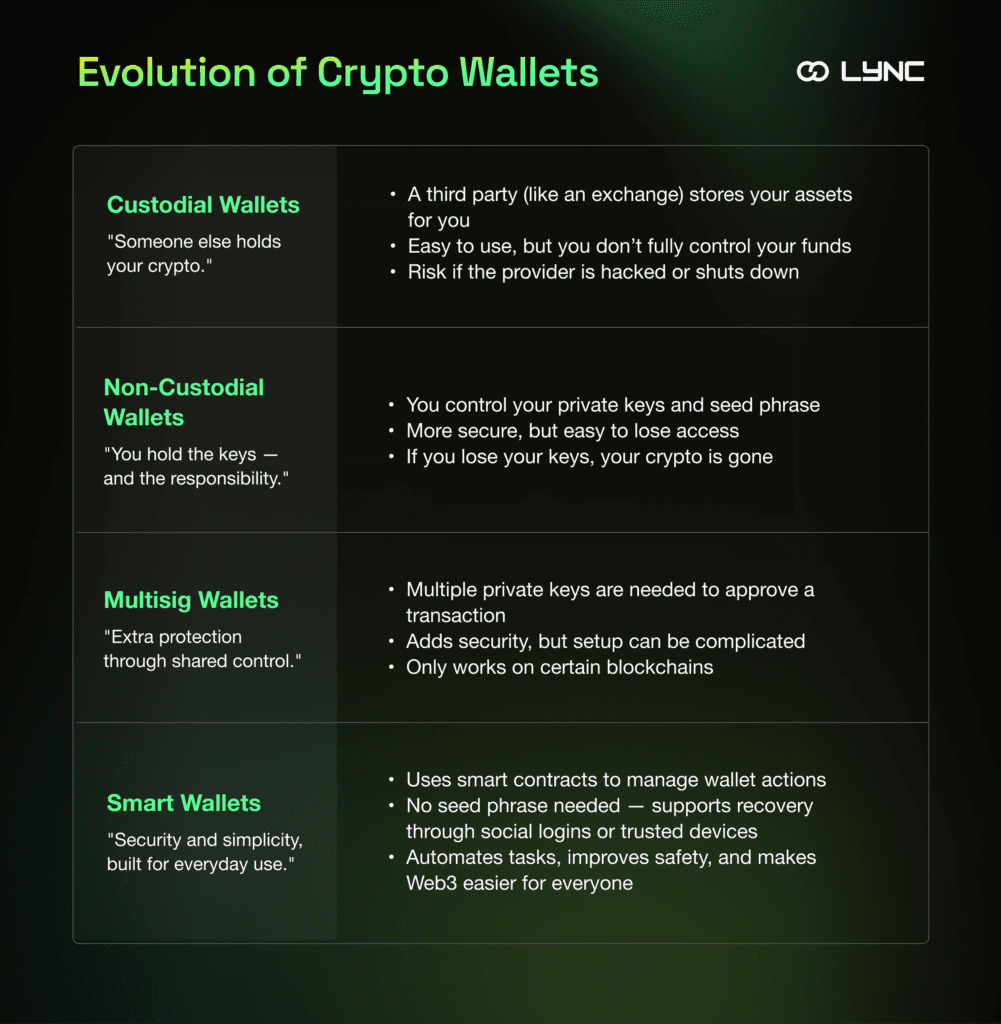
Smart wallets also known as smart contract wallets, are actively reshaping how users interact with crypto. Instead of just storing your private key, these wallets use smart contracts to add extra layers of security and flexibility. This means your wallet can do things automatically, like approving transactions under certain conditions or backing up access without you having to lift a finger.
Think of a smart wallet like a digital assistant for your crypto, making sure everything runs smoothly, safely, and without the usual headaches. Smart wallets make managing your Web3 journey and digital assets easier for everyone, from newcomers to experienced users. Before we get into the specifics of smart wallets, let’s take a brief look at the smart contracts that control the wallets.
Smart contracts are digital agreements written in code on the blockchain. They automatically carry out actions when certain conditions are met, so there’s no need for middlemen. In the case of smart wallets, these contracts control how and when funds can be spent or moved, providing enhanced security and flexibility.
For example, a smart contract could ensure that funds can only be withdrawn after approval from multiple devices or that certain transactions are restricted during specified hours.
The growth of decentralized finance (DeFi) and NFTs has pushed the demand for smarter wallets. According to DappRadar, the DeFi market surpassed $100 billion in total value locked (TVL) in 2023, highlighting how crucial safe, programmable wallets are becoming.
Platforms like LYNC, Argent and Gnosis Safe have popularized smart wallets by combining advanced security with ease of use. LYNC alone has helped onboard thousands of users to smart contract wallets by removing seed phrases entirely and offering intuitive recovery through social logins and trusted contacts.
As AI becomes more connected to Web3, a new kind of crypto wallet is starting to appear: AI-powered wallets. These wallets can do things on their own, like interact with decentralized apps (dApps), make trades, or manage your crypto portfolio based on decisions made by AI. Smart wallets make this possible by offering secure, programmable features that let AI take action without needing you to do everything manually.
Imagine a wallet that automatically reallocates your crypto assets based on market conditions or your personal preferences. This is where smart wallets and AI converge to revolutionize digital finance.
Smart wallets remove some of the biggest hurdles to Web3 adoption:
Instead of storing a long recovery phrase, users can rely on safer, more intuitive methods like social logins or device-based authentication.
Smart wallets minimize the chance of user error by removing the need to manually handle sensitive private keys.
Users can restore access through trusted contacts or multiple device approvals—no more panic if you lose your phone.
A smooth, familiar interface helps onboard new users without overwhelming them with technical details
Smart wallets are transforming how we think about crypto security and usability. By combining the power of smart contracts with user-friendly features, these wallets offer a safer, more convenient gateway into the world of Web3.
No matter your experience level, smart wallets offer a smoother, safer way to handle your digital assets. And with platforms like LYNC simplifying wallet access even further, the future of crypto storage is smart, simple, and ready for everyone. Web3 shouldn’t be complicated. Let a smart wallet do the heavy lifting.
November 27, 2025
The world of competitive gaming is global by nature, yet managing backend operations for such a wide-reaching network is no easy task. For companies supporting this rapid, worldwide growth, the key challenge lies in balancing decentralized community building with consistent,...
Author
November 26, 2025
Digital transactions move fast, yet most payment operations still rely on workflows that slow businesses down. Teams spend hours on manual approvals, reconciliations, compliance checks, settlement processes and operational tracking. As volumes grow, these workflows create bottlenecks that limit how...
Author
November 21, 2025
Crypto wallets have evolved from clunky browser extensions to invisible infrastructure that powers everyday apps. A new generation of apps now provide a wallet inside the product flow itself, so users can sign in, store assets and complete transactions without...
Author
November 19, 2025
In late 2025, two of the internet’s biggest infrastructure providers, Cloudflare and Amazon Web Services (AWS), faced major outages that disrupted millions of websites and apps worldwide. Popular platforms like X (formerly Twitter), OpenAI’s ChatGPT, Slack, Fortnite, and Upwork were...
Author
November 13, 2025
A silent revolution is taking place in the digital world. Intelligent agents are beginning to make decisions, negotiate deals, and exchange value with minimal supervision. This new phase of progress is called the agentic economy, a model where AI-powered entities...
Author
November 7, 2025
The gaming world has always evolved, from arcade machines to consoles, from online multiplayer to esports, but few shifts have been as revolutionary as Play-to-Earn (P2E) gaming. In this model, players no longer just play for entertainment; they play to...
Author
November 5, 2025
E-commerce is no longer about clicks, it’s more about conversations. As users spend more time on chat platforms than on traditional websites, the next frontier of online shopping is emerging inside messaging apps. Leading that charge is Telegram, a platform...
Author
November 4, 2025
The digital economy is evolving beyond human-initiated transactions. As AI becomes more agentic, capable of making autonomous decisions, our financial systems are being redefined. The next logical step is clear: payments that not only execute but also think, adapt and...
Author
October 31, 2025
Digital wallets are the entry point into Web3. They act as the keys to decentralized apps, enabling users to send and receive crypto, verify digital identities and manage assets, without relying on banks or intermediaries. But setting up a wallet...
Author
Unlock special content and connect with others.
Join our community today!


