
gamefi
How GameFi Works: A Complete Guide

Author
Gaming has come a long way from being just a recreational activity. Today, it’s an industry worth billions, with millions of players worldwide competing and socializing. But what if gaming could be more than just entertainment? What if every quest, battle, or achievement could translate into real financial rewards?
A new era of gaming has emerged, integrating blockchain technology with decentralized finance to empower players with true ownership, financial rewards, and control over their digital assets.
But how does this all work? What makes GameFi different from regular gaming? This article talks about everything you need to know about the GameFi ecosystem.
GameFi combines gaming with decentralized finance, allowing players to earn rewards while playing by giving them full ownership of their digital assets through blockchain technology. Unlike traditional video games where in-game items are locked within the game, GameFi games give you full ownership of your digital assets, thanks to blockchain technology.
In regular gaming, in-game assets like skins, weapons, or characters are locked within the game and have no real-world value. However, in GameFi games, these assets exist on a blockchain as NFTs (Non-Fungible Tokens) or GameFi tokens, giving players complete control. Players can trade, sell, or use these assets across multiple GameFi platforms, creating an interconnected digital economy.
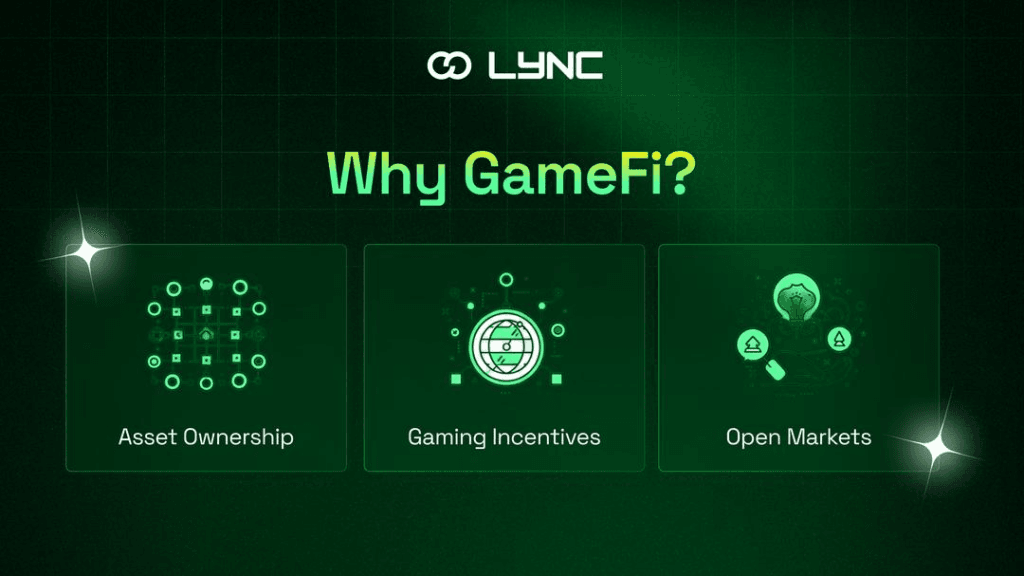
There are several reasons why games that offer GameFi capabilities may be more appealing to gamers.
Generally, blockchains give ownership over every digital asset, nobody can take away assets you own in your blockchain wallet. The In-game asset ownership is a core feature of what GameFi offers to players and a large part of what makes blockchain games unique.
Before blockchain technology, game ownership was entirely at the discretion of publishers, who decided what players could access. With the rise of blockchain games and GameFi, ownership is no longer a privilege—it’s a fundamental right.
Currency and in-game items are frequently obtained as incentives for playing the game. Along with essential gameplay loops, reward systems are an important component of any social game because they provide players with a goal to aim for and encourage them to return for more.
Users can make real money by playing games because these items or currencies can naturally be purchased, sold, and exchanged on open blockchain marketplaces.
One advantage that GameFi gives blockchain games over traditional games is that players have an added motivation to play. While this should never take precedence over the natural desire to play games for their entertaining gameplay dynamics, skill expression, and social benefits, the added incentive of being rewarded for your efforts in a game makes GameFi slightly more appealing than every regular game.
GameFi operates by merging gaming mechanics with decentralized finance (DeFi), creating a self-sustaining economy where players can earn, own, trade, and even invest in digital assets.
GameFi games operate on a blockchain network (e.g., Ethereum, Binance Smart Chain, or Polygon) The blockchain provides:
Each GameFi project is powered by a combination of GameFi tokens, NFTs, and DeFi elements, creating a dynamic gaming economy.
Unlike traditional games where players pay to play, GameFi operates on a Play-to-Earn (P2E) model. Players earn GameFi tokens and NFTs by completing in-game tasks such as winning battles, completing quests, trading assets, or staking tokens.
These rewards have real-world value because GameFi tokens are listed on crypto exchanges and NFTs can be traded in the markets.
GameFi tokens are the native cryptocurrencies used for in-game purchases, upgrades, governance, and staking, while in-game assets like characters, weapons, and land are tokenized as NFTs, allowing players to trade, rent, or use them across multiple platforms.
GameFi operates through smart contracts, which are self-executing programs stored on a blockchain. They automate:
Because smart contracts remove the need for intermediaries, GameFi games can run autonomously, reducing fraud and ensuring fairness.
Unlike traditional games controlled by developers, GameFi crypto projects often use Decentralized Autonomous Organizations (DAOs) to give players control. Holders of governance tokens can:
This decentralization ensures that GameFi platforms evolve based on player input rather than corporate interests.
Axie Infinity was one of the first GameFi crypto projects to introduce the Play-to-Earn (P2E) model, allowing players to earn real money while battling fantasy creatures called Axies.
Players breed, trade, and battle Axies, earning AXS and SLP tokens, which can be traded on cryptocurrency exchanges.
Key Features:
Axie Infinity proved that gaming could become a full-time job, especially in regions where crypto earnings surpass local wages.
Gods Unchained is a free-to-play, NFT-powered trading card game (TCG) where players own their cards as blockchain-based assets.
How it Works:
Key Features:
Sorare is a blockchain-based football (soccer) game where players collect, trade, and compete using NFT-based digital player cards.
How it Works:
Key Features:
Sorare is redefining GameFi crypto projects by bridging fantasy sports with blockchain owners.
GameFi is creating sustainable ecosystems that empower players financially while enhancing their gaming experiences. As blockchain technology evolves, GameFi will offer even more immersive and rewarding experiences.
Whether it’s battling in Axie Infinity or trading digital football cards in Sorare, the GameFi ecosystem is expanding rapidly, attracting both gamers and investors.
As blockchain technology continues to evolve, so will GameFi crypto projects, introducing more immersive, interoperable, and rewarding gaming experiences.
November 27, 2025
The world of competitive gaming is global by nature, yet managing backend operations for such a wide-reaching network is no easy task. For companies supporting this rapid, worldwide growth, the key challenge lies in balancing decentralized community building with consistent,...
Author
November 26, 2025
Digital transactions move fast, yet most payment operations still rely on workflows that slow businesses down. Teams spend hours on manual approvals, reconciliations, compliance checks, settlement processes and operational tracking. As volumes grow, these workflows create bottlenecks that limit how...
Author
November 21, 2025
Crypto wallets have evolved from clunky browser extensions to invisible infrastructure that powers everyday apps. A new generation of apps now provide a wallet inside the product flow itself, so users can sign in, store assets and complete transactions without...
Author
November 19, 2025
In late 2025, two of the internet’s biggest infrastructure providers, Cloudflare and Amazon Web Services (AWS), faced major outages that disrupted millions of websites and apps worldwide. Popular platforms like X (formerly Twitter), OpenAI’s ChatGPT, Slack, Fortnite, and Upwork were...
Author
November 13, 2025
A silent revolution is taking place in the digital world. Intelligent agents are beginning to make decisions, negotiate deals, and exchange value with minimal supervision. This new phase of progress is called the agentic economy, a model where AI-powered entities...
Author
November 7, 2025
The gaming world has always evolved, from arcade machines to consoles, from online multiplayer to esports, but few shifts have been as revolutionary as Play-to-Earn (P2E) gaming. In this model, players no longer just play for entertainment; they play to...
Author
November 5, 2025
E-commerce is no longer about clicks, it’s more about conversations. As users spend more time on chat platforms than on traditional websites, the next frontier of online shopping is emerging inside messaging apps. Leading that charge is Telegram, a platform...
Author
November 4, 2025
The digital economy is evolving beyond human-initiated transactions. As AI becomes more agentic, capable of making autonomous decisions, our financial systems are being redefined. The next logical step is clear: payments that not only execute but also think, adapt and...
Author
October 31, 2025
Digital wallets are the entry point into Web3. They act as the keys to decentralized apps, enabling users to send and receive crypto, verify digital identities and manage assets, without relying on banks or intermediaries. But setting up a wallet...
Author
Unlock special content and connect with others.
Join our community today!


